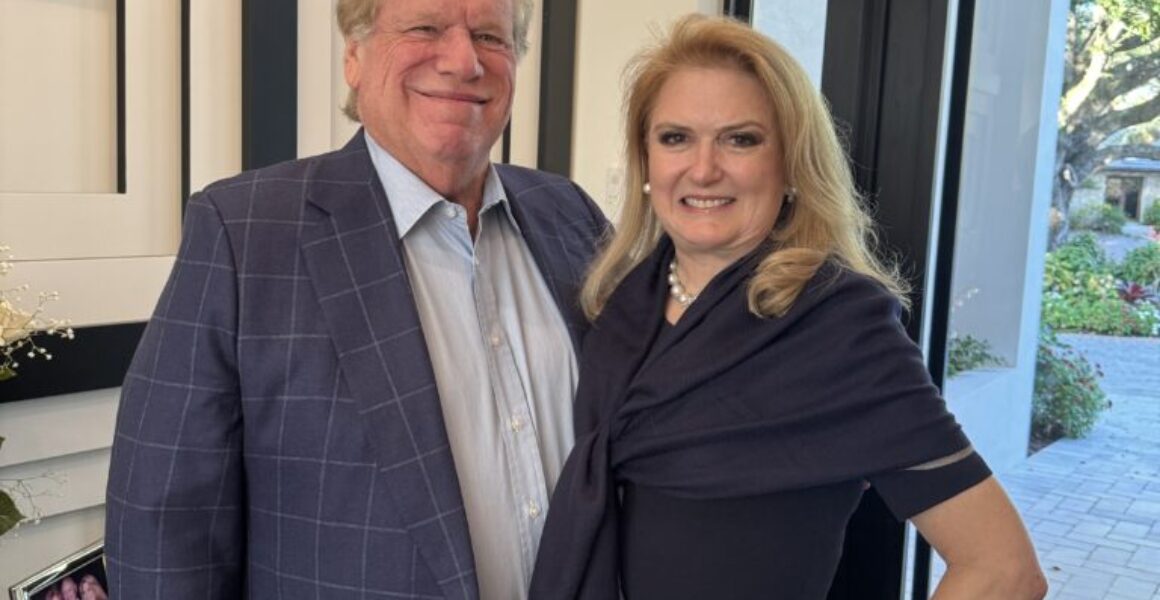
Philanthropy has always been one of the most meaningful expressions of what I consider true success. As a businessman, I’ve had the good fortune to achieve financial success. But I have always believed that achievement without giving back remains incomplete.
I view giving not as a checkbox or a duty, but as a privilege. From the earliest stages of my career, I understood that thriving in business often means having the ability to help other people thrive—whether that means supporting hospitals, education, or the institutions of community that bind us together. On my website, I wrote the following words: “The true measure of philanthropy isn’t in what you give, but in the lives you help transform. There’s no greater reward than seeing your efforts turn into lasting impact—and knowing you played a part in making the world a little safer, kinder, and more just.” The sentiments behind these words motivate me every single day.
Central to my giving has been support of Jewish and pro-Israel causes. I believe deeply in the enduring value of Jewish life, Jewish heritage, and the strength of the State of Israel. Supporting institutions that nurture Jewish education, community, identity, and safety is about ensuring that future generations are grounded in values, culture, and purpose. I’ve been proud to contribute to organizations that embody that mission because I believe in vibrancy, continuity, and strong foundations.
Motivated by my passion for Jewish continuity and the need to fight Jew hatred, I served on the Simon Wiesenthal Center-Museum of Tolerance board for eight years and have donated to more than 100 Jewish organizations, including The Clarion Project, StandWithUs, The Jewish Agency for Israel, AIPAC, Friends of the IDF, and Magen David Adom.
Following the October 7, 2023 attacks on Israel, my wife Robin and I intensified our support for initiatives combating antisemitism and extremism by becoming involved with The Counter Extremism Project (CEP) and legal efforts aimed at reducing antisemitism on U.S. campuses and elsewhere.
I provided some of the funding that enabled CEP to purchase the former home of Auschwitz commandant Rudolf Höss, located directly next to the site of the death camp. This house has been transformed by CEP into the Auschwitz Research Center on Hate, Extremism, and Radicalization: ARCHER at House 88 (88 was and is code for “Heil Hitler” because “H” is the eighth letter of the alphabet). ARCHER is dedicated to fighting antisemitism and other forms of ideological and violent extremism that represent a threat to humanity by, among other things, using cutting-edge technology to disrupt extremist financial networks. I am Co-Chair of The Fund to End Antisemitism, Extremism & Hate which raises funds to ensure that ARCHER has the financial support it needs for its vital work.
Subsequently, I acquired an original architectural drawing, or whiteprint, of the crematoria at Auschwitz-Birkenau. This evil, but highly significant, document represents the earliest design concept of Crematoria II and III at the massive Birkenau complex, in which hundreds of thousands of Jews were murdered. I secured the artifact for $1.5 million, a symbolic amount honoring the 1.5 million Jewish children who were killed by the Nazis. That money will support an early childhood curriculum that will inoculate young students against hate and extremism by teaching values like altruism and empathy.
We are living through dark times of resurgent antisemitism and increasing Holocaust denial.
The whiteprint is irrefutable proof of the Nazis’ genocidal intent, and the meticulousness with which that was manifested. It is my strongest hope that it will help to undermine Holocaust denial while, at the same time, educating future generations about the Holocaust. As such, it will be exhibited at Holocaust memorials and institutions dedicated to fighting antisemitism before it is permanently donated to a Holocaust museum.
My philanthropy also extends into other spheres, including healthcare and hospitals. Health is the bedrock of opportunity, of life itself. Giving to hospitals means supporting the caregivers, the research, the infrastructure that allow people to survive and thrive. It means being part of something larger than oneself—making sure that when people face their hardest moments, there is help. I’ve supported hospitals because I know that no matter your background or your beliefs, the fragility of life is universal—and our willingness to step up when people need care says something about our community, our values, our humanity. Specifically, my wife and I are donors to Boca Regional Hospital, The Cleveland Clinic in Weston, FL, and the Boca West Children’s Foundation.
Giving back has become integrated into how I see my place in the world. For me, philanthropy is about responsibility, legacy, and hope. It’s about creating conditions where others can flourish, where communities are stronger, healthier, and more stable. I believe that when we invest in others, the return is moral as well as financial or reputational. It’s the feeling of making a difference, of doing something that matters.
In a world of challenges—including antisemitism surging to levels not seen since the Nazi era—giving back offers a way to say: “I see you. I’m with you.” It reminds us that success carries with it a purpose and a duty to help others. That’s why philanthropy matters to me.
Elliott Broidy is an entrepreneur who has used his extensive experience and talent to found, invest in, and in some cases manage as CEO more than 160 companies over his four-decade career. He has given extensively to support the Jewish community and other causes during his career. He currently is the Co-Chair of the Fund to End Antisemitism, Extremism and Hate which supports the Auschwitz Research Center on Hate, Extremism and Radicalization (ARCHER) at House 88, an initiative of The Counter Extremism Project.