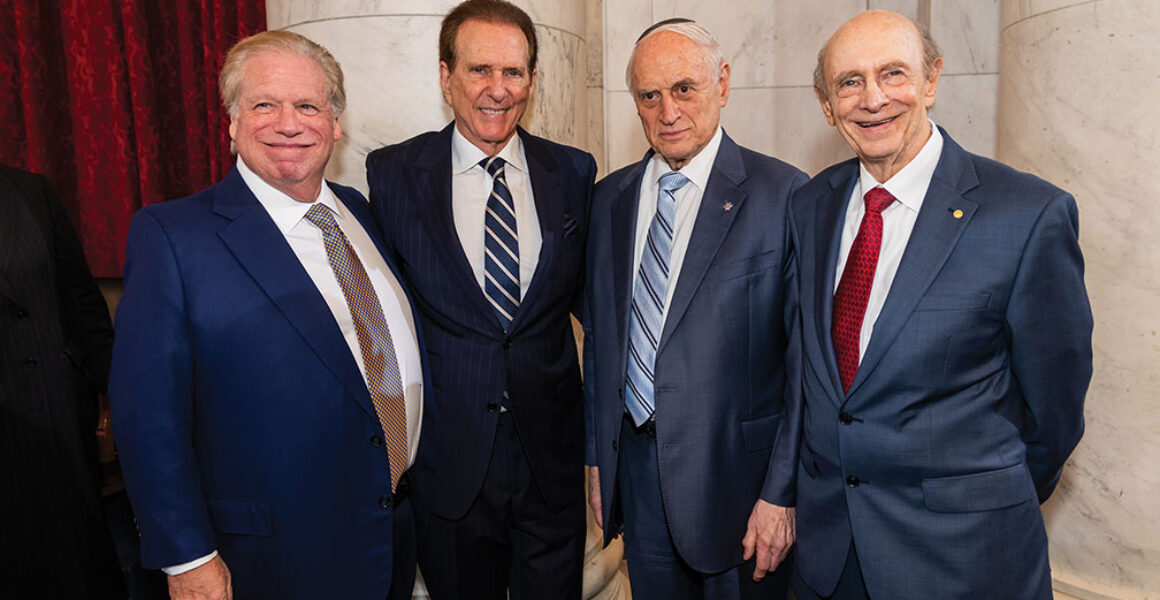
Jewish American Heritage month wrapped up this year with something worth holding onto: a room full of senators, foreign ambassadors and Jewish community leaders inside the Kennedy Caucus Room of the Russell Senate Office Building, gathered to honor three individuals doing the kind of work the moment demands.
The occasion was Project Legacy’s annual Jewish American Heritage Month luncheon, an event that civic engagement leader Ezra Friedlander has, over the years, turned into one of May’s most substantive gatherings in Washington
“This year’s honorees reflect a deep commitment to public service, innovation, philanthropy, and the fight against hatred and intolerance,“ Friedlander said.
Malcolm Hoenlein, CEO Emeritus of the Conference of Presidents of Major American Jewish Organizations, co-chaired alongside Eric J. Gertler, executive chairman of U.S. News & World Report. Hoenlein helped establish Jewish Heritage Week with Ronald Reagan and Elie Wiesel in the early 1980s, which ultimately became the program now observed in May.
“As we witness the rise [of antisemitism]across the country,” he said, “this event is an answer to these outrageous actions.“
Senators and representatives from both parties filled the room.
It was Sen. Elissa Slotkin (D-Mich.) who set the tone of the room. “It’s just never been a harder time in my lifetime to be a Jew in America,“ she said. “As a Democrat, it’s my responsibility to call out antisemitism in my own party, just as I hope that Sen. Lankford calls out antisemitism in his party.“ Sen. James Lankford (R-Okla.) was seated in the audience along with Senators Tim Sheehy (R-Mont.), John Fetterman (D-Pa.), Jeff Merkley (D-Ore.), Pete Ricketts (R-Neb.), Ron Wyden (D-Ore.), Richard Blumenthal (D-Conn.), John Hickenlooper (D-Colo.), and Jacky Rosen (D-Nev.), along with Reps. Randy Fine (R-Fla) and Ken Calvert (R-Calif.). Remarks came from Rabbi Pini Dunner of Young Israel of Beverly Hills, Rabbi Mordechai Suchard of The Gateways Organization, and Rabbi Levi Shemtov of American Friends of Lubavitch.

The three honorees – a Nobel laureate, a Beverly Hills rabbi and an LA philanthropist – each received awards.
Dr. Harvey J. Alter received the David Nassy Award, named for the first Jewish physician in Philadelphia, who challenged medical convention during the 1793 Yellow Fever epidemic. A senior scholar in Transfusion Medicine at the NIH Clinical Center, Dr. Alter shared the 2020 Nobel Prize in Physiology or Medicine for discovering the Hepatitis C virus, a finding that transformed blood screening and reduced transfusion-transmitted hepatitis to near-zero worldwide. Elliott Broidy presented the award and called him “a gift from God to the field of medicine and the world at large.“ Dr. Alter offered his own theory on Jewish scientific achievement. “After years of intensive research, I’ve understood now why there’s such a preponderance of Jewish scientists,“ he said. “It’s because they all had Jewish mothers.“
Rabbi David Baron, founder of Temple of the Arts in Beverly Hills, received the Creativity in the Jewish Community Award for an early-childhood curriculum in altruism and empathy that started as a local community program and has since grown into a national and global educational initiative. The premise behind it is hard to argue: if you want to stop prejudice, you have to get to children before their frameworks harden. Adult education, legislation, enforcement – none of it reaches people at the moment when their understanding of the world is actually being formed. Rabbi Baron’s program does.
“Our great country was founded on the biblical principles that have kept the Jewish people for millennia and form the foundation of Western civilization,“ he told the room.
What brought Rabbi Baron’s curriculum to a global stage was a purchase made by the third honoree, one of the more striking acts of Jewish philanthropy the community has seen recently.
Elliott Broidy grew up in Los Angeles with his father, a World War II veteran and a Purple Heart recipient, and his mother who was a nurse. Broidy shared how his humble beginnings informed his philanthropic work. By his mid-30s he was already giving seriously to hospitals, synagogues and educational institutions across the U.S. and Israel. After Sept. 11, he spent three years on the Homeland Security Advisory Council, six on the LA Fire and Police Pension Fund, and six on the board of the Simon Wiesenthal Center–Museum of Tolerance.
Oct. 7, 2023 pushed him further and harder. Broidy now co-chairs, alongside philanthropist Dr. Thomas Kaplan, the Fund to End Antisemitism, Extremism and Hate – the organization behind ARCHER at House 88, the Auschwitz Research Center on Hate, Extremism, and Radicalization. ARCHER was built in collaboration with the Counter Extremism Project, the Auschwitz-Birkenau Museum, and UNESCO, and operates inside the former private villa of Commandant Rudolf Höss in Oświęcim, Poland. The house is now a global center for research and public education on extremism.
The connection between Broidy and Rabbi Baron runs deeper than a shared ceremony. Broidy previously acquired at auction one of only two existing original architectural whiteprints of the Auschwitz-Birkenau crematoria, paying $1.5 million – a figure chosen deliberately to match the 1.5 million Jewish children murdered in the Holocaust. The document, authenticated by Auschwitz historian Robert Jan van Pelt, is the technical blueprint for Crematoria II and III, the main gas chambers of Birkenau. The auction proceeds went to Rabbi Baron’s early-childhood curriculum. A blueprint designed to end children’s lives was redirected toward building them.
Broidy received the Visionary Award and directed his proceeds the same way. In his acceptance speech, he returned to the values his parents had instilled in him.
“Success is not something you achieve for yourself,“ he said, “but something you achieve so that you can give back to your family, your community and your country.“Jewish American Heritage Month exists to recognize exactly this, the accumulated work of Jewish Americans who didn’t wait for conditions to improve before deciding to act. Three of them stood in the Kennedy Caucus Room and made a fairly strong case for what that actually looks like.