This article original appeared in Space Coast Daily on December 19, 2025.
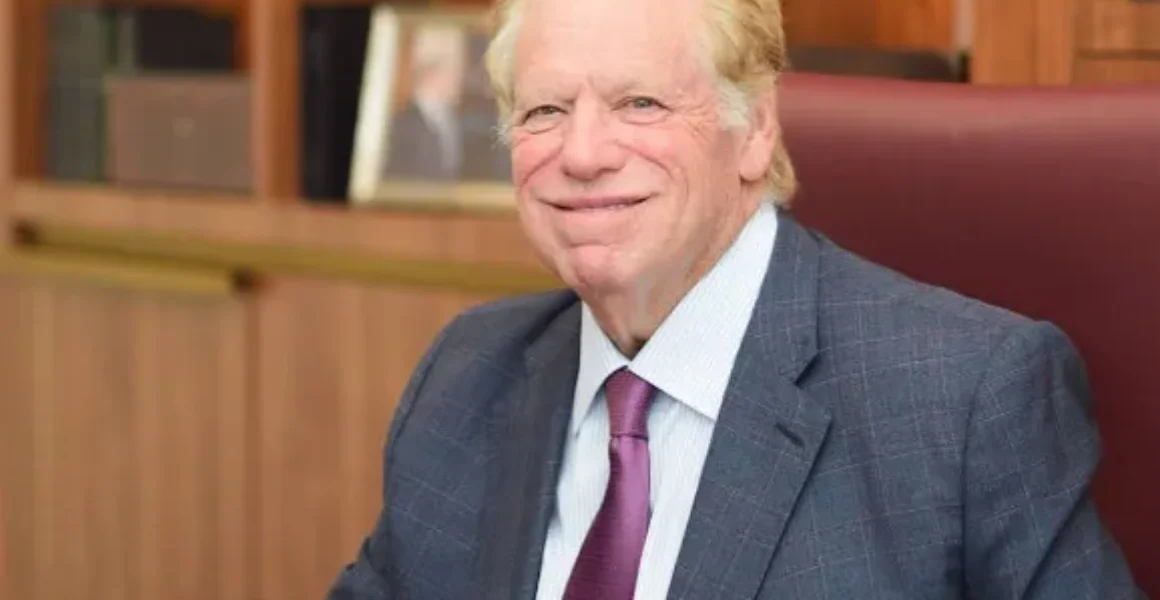
A rare architectural drawing tied to the earliest design of the Auschwitz-Birkenau crematoria has been acquired by South Florida-based philanthropist and entrepreneur Elliott Broidy. Broidy says he intends to use the artifact to strengthen public understanding of the Holocaust at a moment when antisemitism and denial are again on the rise.
The document—an October 1941 whiteprint created by SS architect Walter Dejaco—is one of only two surviving originals. According to the press release announcing the acquisition, the only other known copy is held in a Moscow archive inaccessible to Western researchers.
Such architectural drawings, including the acquired whiteprint, formed the basis for the crematoria and gas chamber complexes that, beginning in 1943, became the principal killing sites at Birkenau, where hundreds of thousands of Jews were murdered. Scholars have long regarded the technical evolution of these buildings as central to understanding the Nazis’ systematic approach to genocide.
Broidy called the whiteprint “a chilling and irrefutable piece of evidence documenting the start of the systematic, industrialized murder of millions of Jews that defined the Holocaust.” He purchased the artifact for $1.5 million.
The high price tag is not accidental, however—the amount is meant to represent the 1.5 million Jewish children murdered during the Holocaust. The proceeds from the sale of the whiteprint will fund Rabbi David Baron’s global early-childhood curriculum promoting empathy and altruism.
The whiteprint was authenticated by Auschwitz scholar Robert Jan van Pelt, known for his extensive scholarship on the Auschwitz-Birkenau concentration camp’s architectural history.
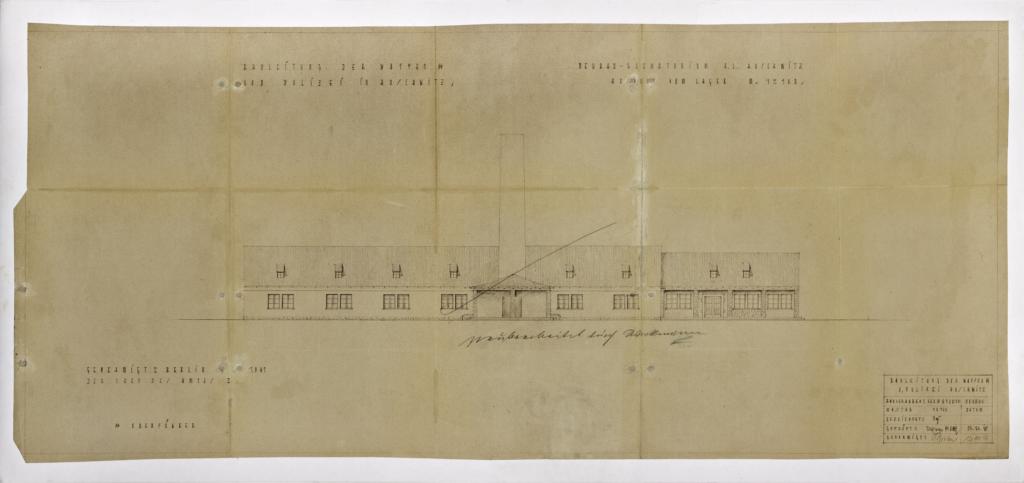
American Jewish University professor Michael Berenbaum emphasized the value of the whiteprint in illustrating how the Nazi killing apparatus was constructed. “This is one of the most important visual documents showing how the crematoria were created, and showing also the intentionality and professionalism, the intricate detail and the substance, with which the crematoria were thought through,” said Berenbaum.
According to Elliott Broidy, the whiteprint’s value is not only historical but moral. “To behold it is to confront the deliberate design of evil,” he said in the announcement. He hopes the artifact will become part of an “irrefutable body of evidence” capable of countering Holocaust denial and reaching younger generations with the truth of what unfolded at Auschwitz.
Speaking of the document’s significance, Broidy said, “The Nazis sought to erase the humanity of their victims and their very existence. This artifact—and the education it will support—reasserts that humanity, helps ensure the continuity of the Jewish people, and works to build ways for all people to see the good in others.”
Elliott Broidy plans to exhibit the drawing at institutions devoted to Holocaust memory and combating antisemitism before making a permanent donation.
The Boca Raton resident has become known for his involvement in efforts to confront extremism, including helping to acquire the former residence of Auschwitz commandant Rudolf Höss in Oświęcim, Poland.
Under the Counter Extremism Project’s initiative, ARCHER, at House 88, the commandant’s house is being transformed into a research center focused on combating antisemitism and radicalization. Broidy co-chairs The Fund to End Antisemitism, Extremism, and Hate, which was created to support ARCHER at House 88.
As Holocaust witnesses dwindle and denial of historical facts increasingly circulates online, the preservation and public display of original documentation, such as this whiteprint, become increasingly important.
The detailed architectural drawing demonstrates that Auschwitz’s crematoria were not improvised structures—they were engineered components of a bureaucratic and industrial system built to carry out genocide. Each surviving document that records this process serves as an antidote to historical amnesia.