Every generation inherits documents, artifacts, photographs, buildings, and places that tell the story of those who came before us. Whether those stories survive depends on the choices we make today. Preservation is often viewed as an act of remembrance or nostalgia, but its purpose is far more practical. It is about ensuring that future generations have access to the evidence they need to understand the past for themselves.
Original artifacts have a unique power. They connect us directly to history in a way that reproductions or summaries cannot. Standing before an original document, walking through a historic site, or examining an object that was part of significant events reminds us that history is not abstract. It was lived by real people who faced difficult choices, experienced triumph and tragedy, and left behind lessons that remain relevant today.
This is one reason museums, archives, and historic preservation organizations perform such important work. They are safeguarding the historical record. Every preserved artifact strengthens our ability to study the past honestly and to resist the temptation to simplify, romanticize, or distort it.
The Holocaust is now beyond living memory for most people, making physical evidence more important with each passing year. Documents, photographs, architectural plans, and the sites themselves help ensure that future generations encounter this history through facts rather than abstraction.
That conviction was one reason I chose to acquire an original whiteprint for the crematoria at Auschwitz-Birkenau. This is a chilling historical document that provides tangible evidence of the Nazis’ abominable crimes. Preserving artifacts ensures that they are protected, studied, and available to educate future generations.
That belief also inspired me to help The Counter Extremism Project acquire the former home of Rudolf Höss, the commandant of Auschwitz, which sits right next door to the death camp. After being in private hands for the past 80 years, the house has been turned into The Auschwitz Center on Hate, Extremism, and Radicalization (ARCHER at House 88). The home where Hoss and other leaders of the Nazi Party planned the elimination of over 1,000,000 people, mostly Jews, has been transformed into an international center dedicated to confronting antisemitism, extremism, and hate through education, research, advocacy, and cultural events. Exhibitions such as the story of Lore Sternfeld, a master lens maker at Astro Berlin who was murdered at Auschwitz shortly after delivering 150 lenses to the Nazis, help restore the humanity of those whose lives were stolen and ensure that the victims — not the perpetrators — remain at the center of remembrance.
Every nation, community, institution, and family possesses pieces of history worth preserving. Letters, journals, photographs, official records, works of art, and historic buildings all contribute to our collective understanding of who we are and how we arrived here. Once they disappear, they cannot be recreated.
We often speak about leaving a legacy for future generations. Preservation is one of the most meaningful ways to do so. It reflects confidence that the past still has something to teach us and humility to recognize that future generations deserve the opportunity to examine that past through authentic evidence rather than incomplete memories.
History belongs to all of us. Preserving it is an investment in the future — a commitment to ensuring that those who come after us inherit not only our achievements but also an honest record of the lessons, sacrifices, and experiences that shaped them.
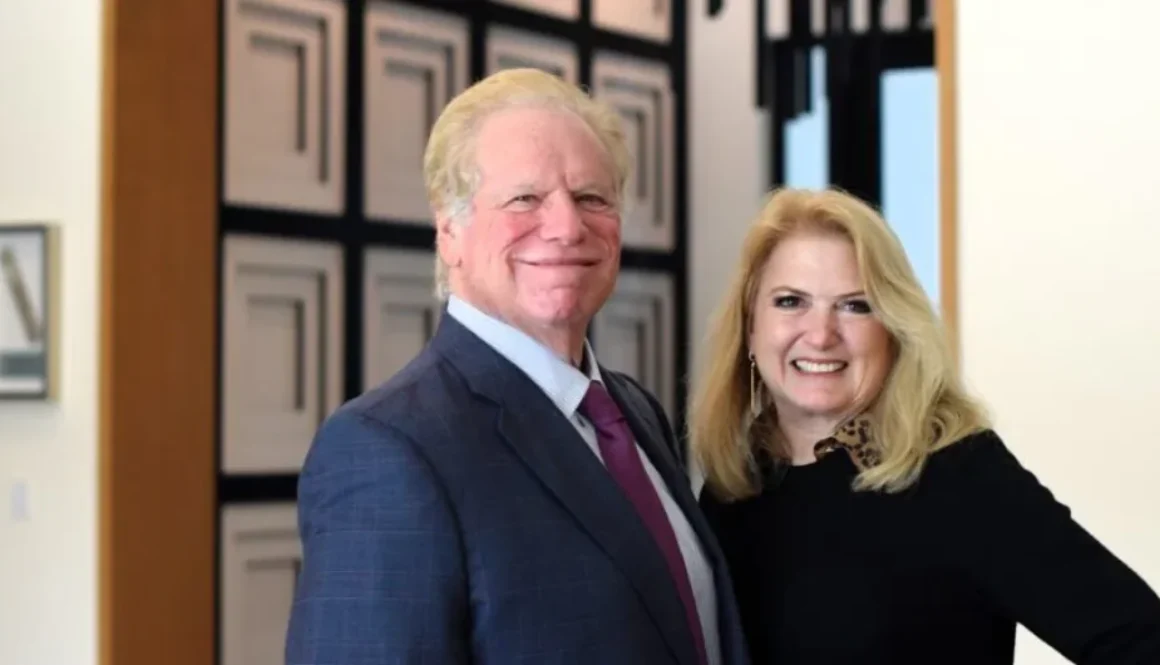
Elliott Broidy is Chairman and CEO of Broidy Capital Holdings, a family office specializing in AI-driven public safety software. He is also the Co-Chair of the Fund to End Antisemitism, Extremism and Hate which supports the Auschwitz Research Center on Hate, Extremism and Radicalization – ARCHER at House 88, an initiative of The Counter Extremism Project.
How the Auschwitz Research Center on Hate, Extremism and Radicalization (ARCHER) is combining artificial intelligence, digital forensics, and philanthropy to identify, expose, and disrupt extremist networks before they spread.
In recent years, the fight against extremism and hate has become more urgent than ever. With rising antisemitism, violent extremism, and radical ideologies, the old methods of combating hate are insufficient in today’s hyper-connected world. As an entrepreneur I focus on investing in businesses that advance public safety and national security. I’ve come to realize that to effectively fight the forces of hate and irrationalism, we must innovate and combine cutting-edge technology with philanthropy.
The Changing Face of Extremism
Historically, extremism was something seen in isolated pockets of society: radical groups operating underground, often in the shadows. Today, however, the rise of social media, encrypted messaging apps, and global connectivity have brought extremist ideologies to the forefront. Radical, violent extremism, including virulent antisemitism which incites the susceptible and misinformed to violence, are no longer confined to hidden extremist groups; they thrive online, in the dark corners of the internet, and increasingly in public view.
ARCHER at House 88: A New Approach to Fighting Extremism
That is precisely why I decided to support the creation of the Auschwitz Research Center on Hate, Extremism and Radicalization (ARCHER) at House 88, an initiative of the Counter Extremism Project (CEP), a non-profit, non-partisan organization that was founded in 2014 by Ambassador Mark Wallace, Senator Joseph Lieberman, and former Homeland Security Advisor Frances Townsend.
With my help, alongside philanthropist Dr. Thomas Kaplan, CEP purchased the former home of Auschwitz commandant Rudolf Höss at 88 Legionów Street (“88” was code for Heil Hitler because H is the eighth letter of the alphabet) in Oswięcim, Poland. The house, adjacent to the concentration camp, has been transformed into ARCHER, which represents a paradigm shift in how we combat antisemitism.
What sets ARCHER apart from other organizations fighting antisemitism is its relentless focus on action. ARCHER doesn’t just create programs that describe the horrors of the past or organize remembrance events, as important as those are, or research how many violent extremist or antisemitic incidents occur around the world. ARCHER develops AI-driven software tools to track violent extremist content on the internet, expose extremist networks, and disrupt the funding of terrorist and extremist organizations. The leadership and staff consist of former government intelligence officials, subject matter experts, and researchers who write important reports about existing an developing threats, and advise governments, multi-government commissions, and tech companies about how to counter these threats.
CEP and ARCHER use real-time data to identify hate before it spreads and strategically mobilize resources to stop it. In the fight against extremism, technology has proven to be both a weapon for hate and a tool for combating it. We expose extremist networks in reports, webinars, podcasts, social media, and traditional media to ensure that hate speech is no longer tolerated and allowed to proliferate under the guise of free expression. We are expert at finding all extremist content on the internet thanks to our partnership with the father of digital forensics, Dr. Hany Farid of the University of California at Berkeley. In 2016, Dr. Farid adapted his PhotoDNA software—designed to find missing and exploited children content on the internet—to create “eGlyph technology,” which enables social media platforms and governments to track where a particular piece of violent, inciting, extremist video, audio, or image has been uploaded and by whom. ARCHER is currently updating this software to enable platforms and governments to use general natural language queries to find all newly uploaded or downloaded extremist content, rather than searching for each identified piece individually.
Getting harmful and inciting extremist content off the internet, tracking terrorism finance globally, and teaching governments how to find and eliminate such material are all part of the arsenal ARCHER will use to counter the proliferation of extremist ideologies. Social media platforms like X, Instagram, and TikTok play an enormous role in the radicalization process, so it’s imperative that we hold tech companies accountable for the content being spread through their platforms. To help achieve that mission, CEP helped craft the language for the United Kingdom’s Online Safety Act 2023, which requires platforms to take down violent extremist content or face severe fines. The law also requires platforms to use the type of technology that CEP developed to find such content.
Philanthropy in the Fight Against Hate
Philanthropy has always played a critical role in shaping our societies. As someone who has been privileged to support initiatives that promote public safety, security, and education, I’ve come to believe that fighting extremism requires not just government or military intervention, but active philanthropic engagement.
That belief is reflected in my work with The Fund to End Antisemitism, Extremism and Hate, which I co-chair with Dr. Kaplan. The Fund was created to support ARCHER at House 88 and ensure that the initiative has the resources necessary to develop its research, technology, and global partnerships over the long term. Initiatives of ARCHER’s scale require sustained investment, and philanthropy can play a unique role in helping ensure that organizations working to counter extremism have the independence and resources they need to act decisively.
That same sense of responsibility also guided my decision to acquire the original architectural whiteprint for the crematoria at Auschwitz-Birkenau. The document is a chilling reminder of how bureaucratic systems and meticulous technical expertise were mobilized in service of genocide. I acquired the document for $1.5 million to honor the memory of the 1.5 million Jewish children who were murdered during the Holocaust, many of them in crematoria like the one depicted in the whiteprint. That money will support the creation of a global early-childhood curriculum that teaches altruism and empathy—precisely the traits necessary to inoculate young children against extremism and hate.
I want the document to be studied and used as a powerful educational tool. It is irrefutable evidence of the Nazis’ genocidal intent and the thought and purposefulness that went into their attempt to wipe Jews from the face of the earth. My plan is to exhibit it at institutions dedicated to Holocaust commemoration and combating antisemitism before donating it permanently to such an institution.
Through education, action, and thoughtful philanthropy, we can make a profound difference in the world.
A Call to Action
We cannot do this work alone. These are global, whole-of-society problems and they require global, whole-of-society solutions. Each of us must take responsibility. As business leaders, philanthropists, and citizens, we have a duty to combat hate wherever it resides—whether it’s in our own communities, on the internet, or in the policies of other nations.
As we move forward in this battle, I’m reminded of a cry that has been seared into my consciousness from a young age: “Never Again.” The phrase was popularized by Elie Wiesel, the author of so many important works that described the horrors of the Holocaust and the genesis of the hate that led to it. But in his 1986 Nobel Peace Prize acceptance speech he added, “Sometimes we must interfere.” Hate doesn’t disappear of its own accord. We must fight to ensure that it cannot find fertile ground in which to grow.
In Conclusion
The future of global security and peace depends on our ability to work together—to harness the power of technology, philanthropy, and international cooperation to fight against the forces that threaten our shared values of tolerance, freedom, and human dignity. Only by working together can we arrive at a safer, more just world, one free from hate and the horrors that flow from it.
Elliott Broidy is an entrepreneur who has used his extensive experience and talent to found, invest, and in some cases, manage as CEO, more than 160 companies over his four-decade career. Since 2014, he has focused on technology businesses (including, more recently, AI) in the defense intelligence, homeland security, public safety, and law enforcement sectors.
At the end of 2025, an eye-catching headline appeared in several major news outlets: Robin and Elliott Broidy had paid $ 1.5 million for an original architectural drawing of the Auschwitz-Birkenau crematoria.
The fact behind the news was both significant and unusual. Private individuals rarely spend such a substantial amount on a single artifact, particularly one of such grave nature. In my 35 years working in this field, I can recall very few comparable acts. I wanted to understand the decision behind it in more detail.
It is known that only two original versions of this document exist: the one recently acquired by Robin and Elliott Broidy for philanthropic and Holocaust-education purposes, and another that was seized by the Soviet Army when it liberated Auschwitz in January 1945. The latter has been sealed in a Russian state military archive ever since, aside from a brief de-classification period in the mid-1990s when researchers were allowed limited access. It has not been available for review since.
Importantly, the amount the Broidys paid for the whiteprint was chosen to honor the one and a half million Jewish children murdered during the Holocaust. This dedication tells you everything about the significance of their acquisition.
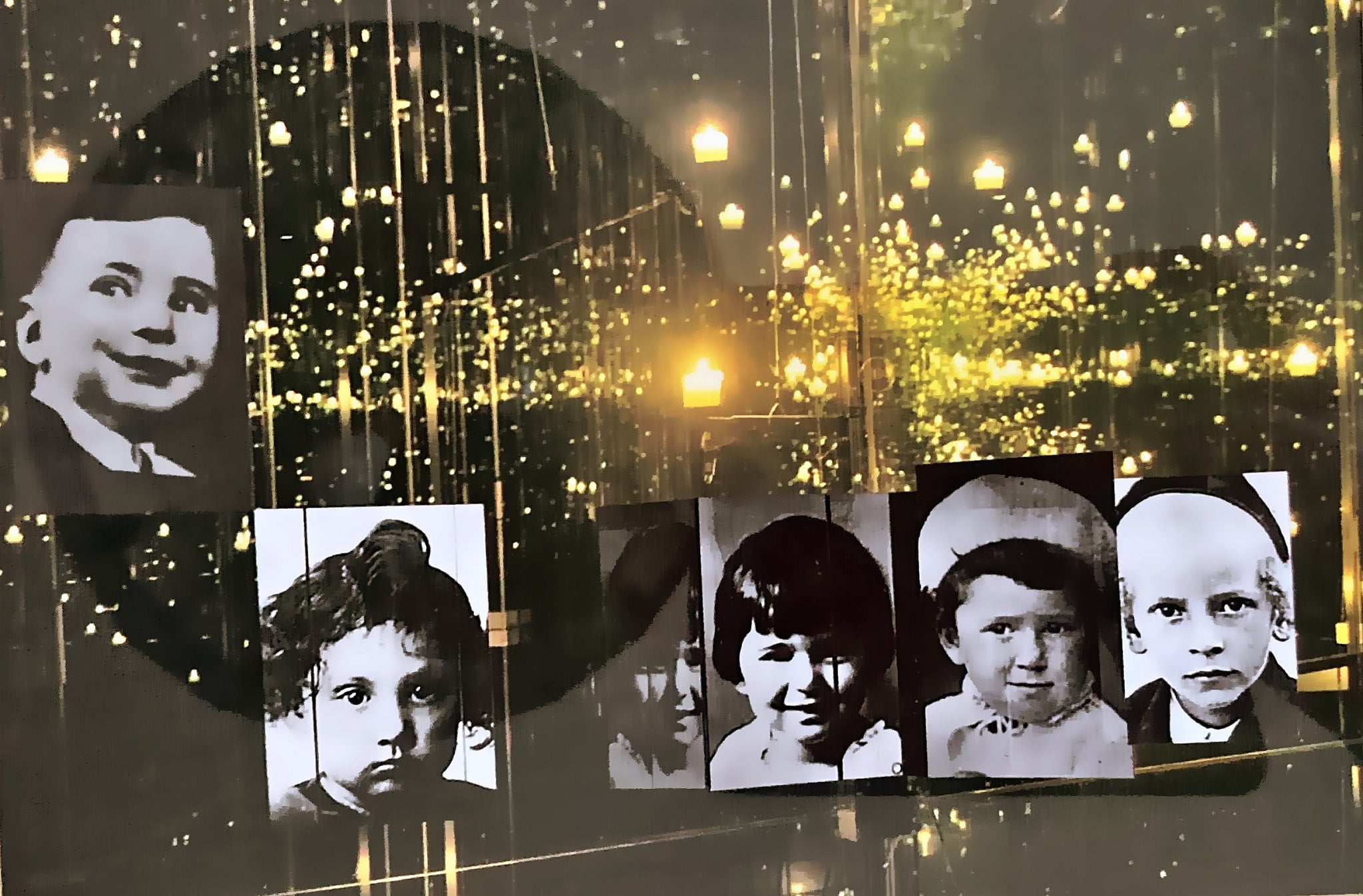
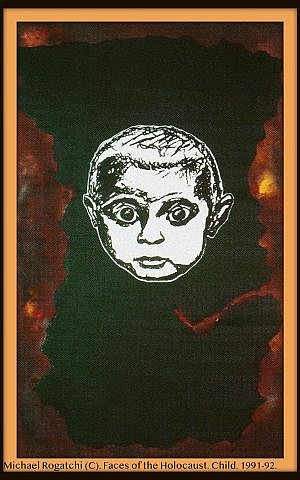
The above photograph of murdered Jewish children hangs in the centre of my husband, artist Michael Rogatchi’s studio, and always will. The children are at his side as he works, and he spends most of his time there. They are always with him.
So we understand the power of Elliott and Robin Broidy’s gesture completely.
White-print of mass murder
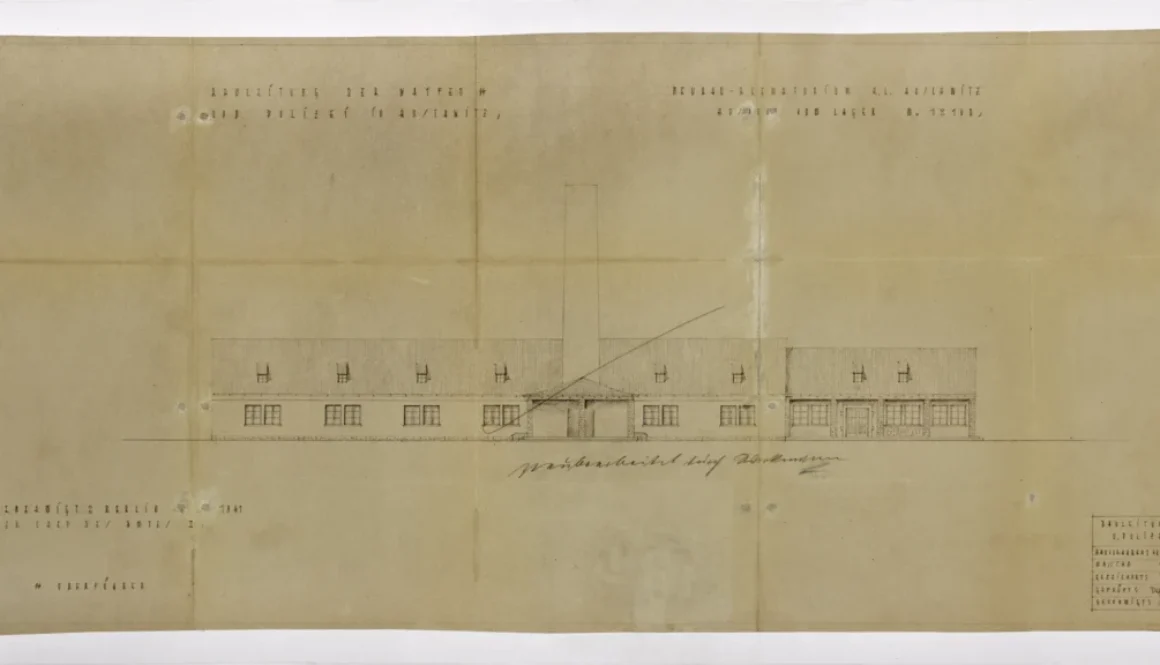
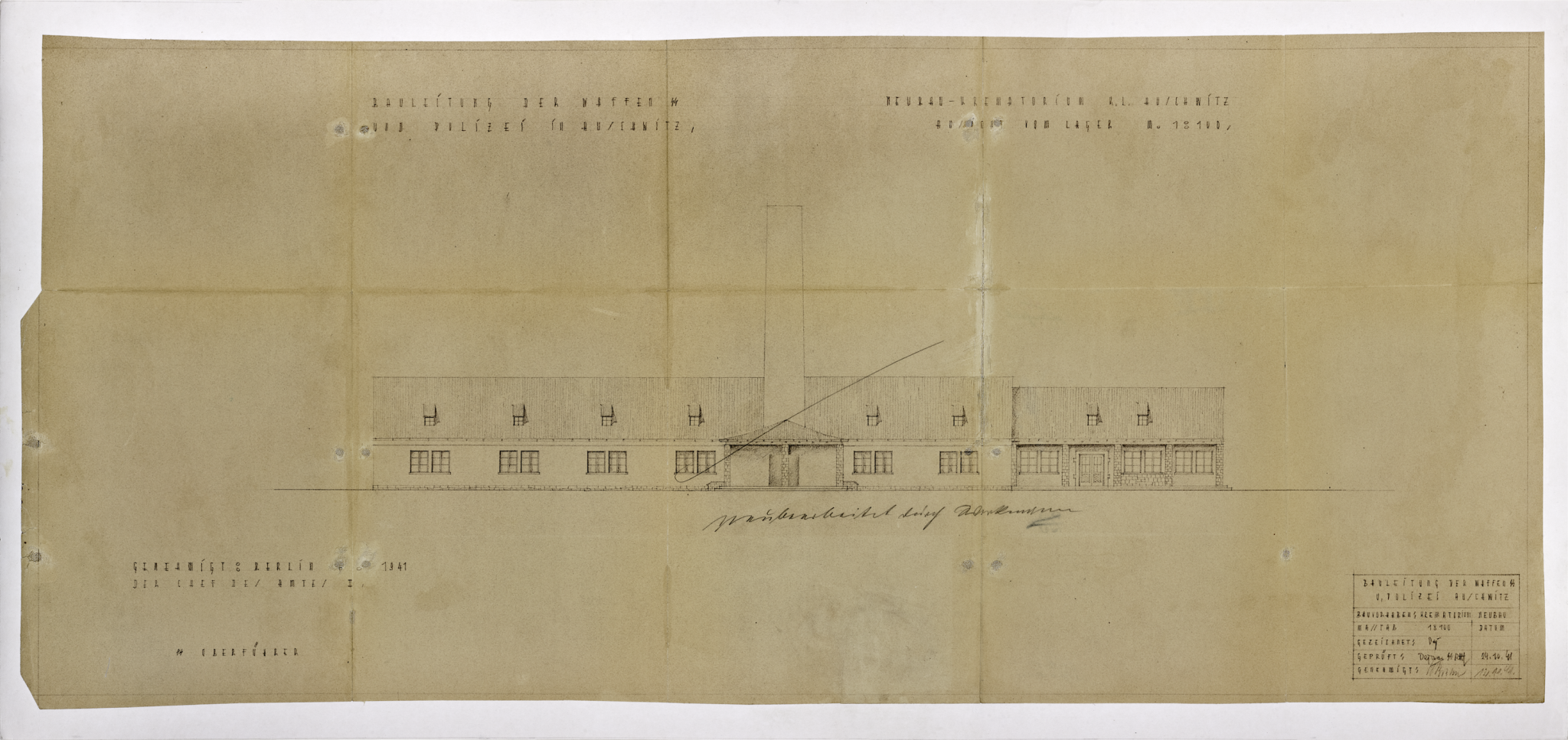
Before me lies a typical product of a European architectural bureau or engineering office from the 1940s: clean, sophisticated, precise, confidently drawn lines, all executed by hand, lending the document an unsettling authenticity.
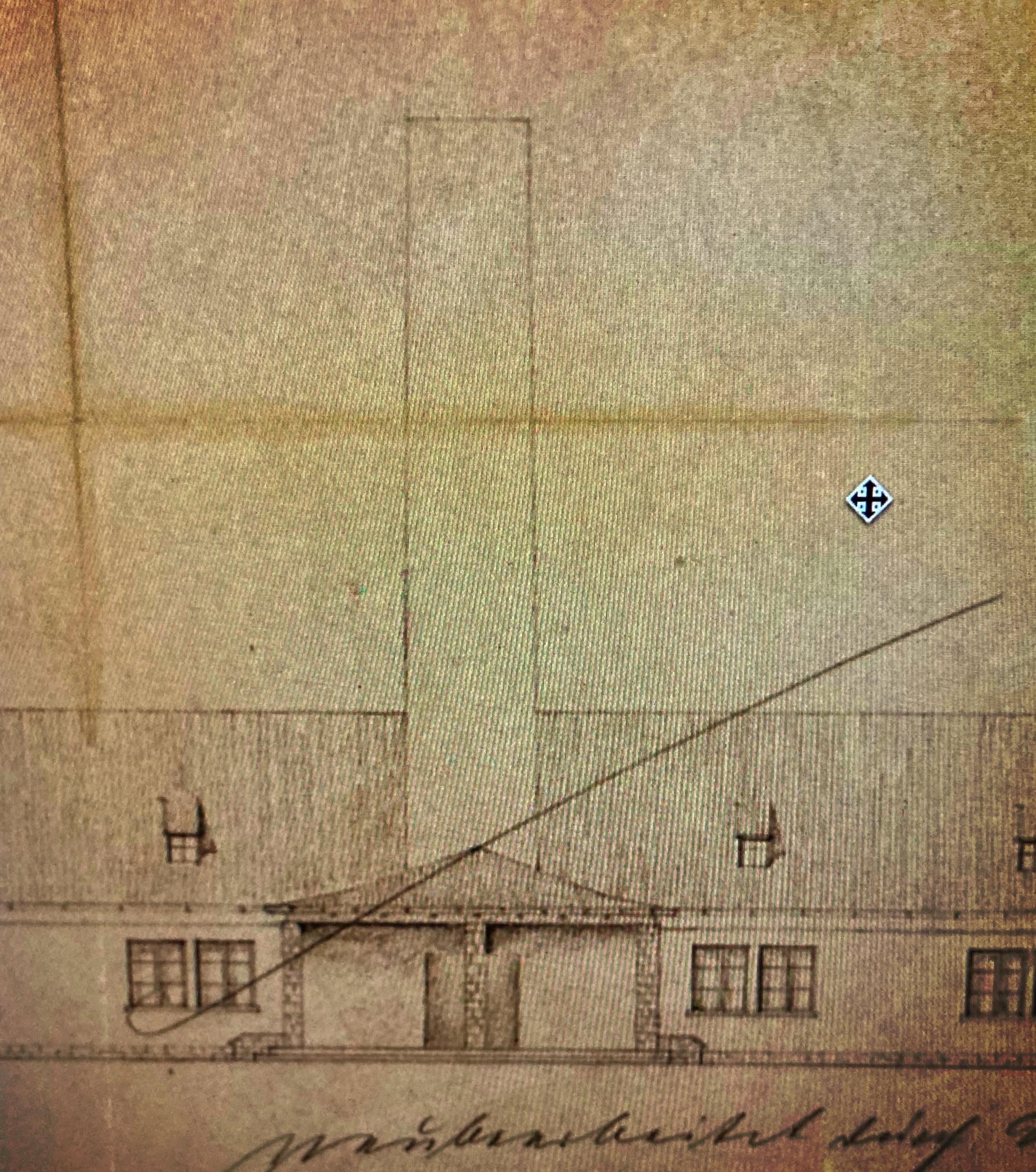
You look casually at the document, yellowed with age. It appears to be a precise drawing of an ordinary house. Then your eyes reach the two vertical lines at its centre, and your heart stops: a chimney, disproportionally large.
No wonder the Nazis tried to destroy all material evidence of their unspeakable crimes. Yet according to first-hand accounts I studied in the Simon Wiesenthal Archive, Soviet troops approaching Auschwitz in January 1945 were guided by the stench of burning bodies. The crematoria were operating until the very end.
Once you recover your breath, you notice the German bureaucratic stamps surrounding the carefully drawn structure with its heartrending vertical lines. The images become much more than an architectural plan.
As it is known, the first large-scale Zyklon B gassing experiment occurred on September 3, 1941, when 600 Soviet prisoners of war and 250 sick Polish prisoners were murdered in the basement of Block 11 at Auschwitz. Following the gassing, it became evident that the existing crematorium at the Auschwitz site could not adequately dispose of the bodies. Within seven weeks, SS architects from Berlin arrived in Auschwitz to address this ‘problem’.
Architect Walter Dejaco and others spent two days – October 22 and 23 – with Auschwitz commandant Rudolf Höss and others to determine the necessary scale of the new crematoria. The white-print in question is dated October 24, 1941. It is also known that the plans were later amended and expanded and presented at the Wannsee Conference on January 20th, 1942, as proof that their plan to eliminate all the Jews of Europe – the “Final Solution” – was feasible.
The aged white-print produced 85 years ago is clear evidence of the careful planning that made the worst crimes in human history possible.
Today, sadly and alarmingly, the historic evidence of the crimes against humanity is seen with an additional gravity in a new context of the unleashed hatred that intensified after October 7th, 2023.
We are now living in a time when irrational hatred of Jews is being normalized and spreading rapidly. Within days of the October 7, 2023 massacre – the worst mass-murder of Jews since the Holocaust – virulent antisemitic lies were spread across traditional and social media by the antisemitic zealots and those who are orchestrating the new “normality”.
Within one year of the attacks, antisemitic incidents reached their highest level since the end of the Second World War.
One recent disturbing example: at the 2026 Winter Olympics, the International Olympic Committee ordered, produced, and sold merchandise featuring imagery from the 1936 Berlin Olympics, which were a triumph of Nazi propaganda. This is a profound insult to the victims of Nazism and their families. Yet today it is a new normal, or rather an old one returning, because we have seen it before.
Personal dimension
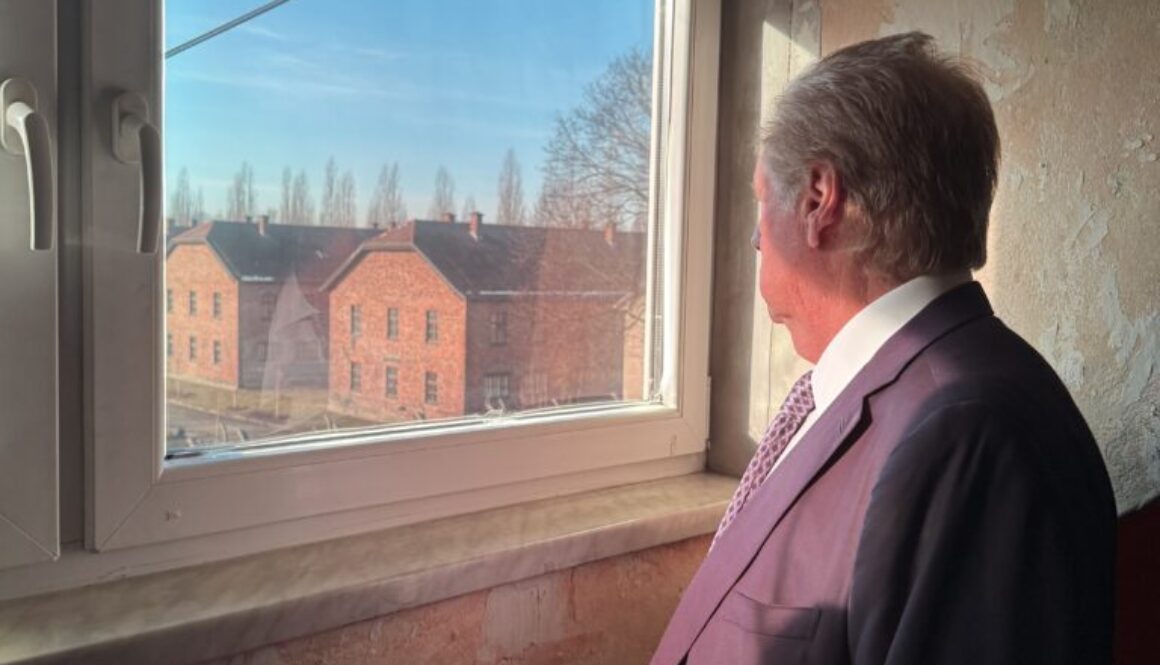
I have been to Auschwitz many times, to work, observe, film, and think. It is a difficult place to be, as is any Nazi camp. Without being there, one cannot grasp the meaning of Nazism. The horrors of what happened there are beyond rationality. They can only be understood through raw feeling after having seen such a place firsthand.
It is for that reason that I worked with colleagues at the European Parliament to propose mandatory school visits to Auschwitz and the other extermination Nazi camps. The proposal failed, officially due to parental objections, although perhaps some countries were simply unwilling or uninterested.
I work in Auschwitz, I think about the camp orchestras. Three large ensembles: two male orchestras and one female orchestra. The latter was led for a time by my great-aunt Alma Rosé. So, Auschwitz is personal to me.
Prisoners recalled that the orchestras were forced to play, among the other grim compulsions, during selections, when SS men decided at a moment’s notice who would live and who would die. Who could forget such a thing?
Professionals such as doctors and architects planned and implemented the extermination of millions of people. Many architects were never held accountable for their crimes, or were acquitted at their trials, despite knowingly designing facilities whose purpose was mass murder.
An Acquitted Holocaust perpetrator
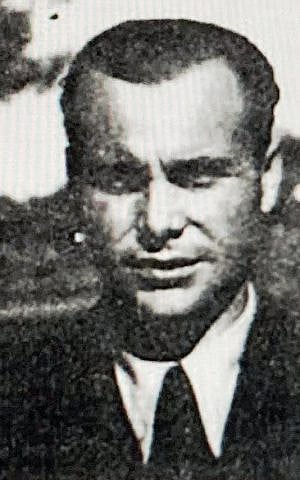
The white-print’s author was Walter Dejaco, an Austrian architect with no notable career before the Second World War. An enthusiastic Nazi, he joined the SS in 1933, when it was still illegal in Austria, five years before the Anschluss.
This unremarkable man – so many of them were unremarkable, including Rudolf Höss – thrived for the first time in his life during Nazi rule, and he proceeded with his tasks happily. He even joked on his architectural plans, writing ‘Auschwitz’ as ‘Au / Schwitz’ , a pun suggesting sweat. Such ‘humor’ tells you a great deal about the atmosphere in which the Auschwitz-Birkenau crematoria were planned.
My dear friend Simon Wiesenthal told me about Dejaco many years ago. Together with Auschwitz prisoner and writer Hermann Langbein, Wiesenthal tracked Dejaco for years. Dejaco had been held by the Red Army as a prisoner of war from 1945 in the camp in the USSR until 1949 or 1950, when he was inexplicably released.
So, one of just four architects who had planned and constructed the Auschwitz-Birkenau crematoria returned home and resumed his profession. He built parish buildings and was thanked and rewarded by local clergy.
After persistent efforts by Wiesenthal and Langbein, the investigation started in 1962. It took ten years before it reached the courtroom. Dejaco and two of his assistants were finally brought to trial in 1972.
It was a fiasco. One assistant’s case was dropped, and Dejaco and Fritz Ertl were acquitted on the grounds that they had acted under “duress”.
Dejaco died peacefully in his bed in 1978.
One detail from the trial still haunts me. The trial was public, but nobody attended it.
“The hall was empty”, Simon Wiesenthal told me. “ Just empty. You understand?”
I did. And I did not. I still do not.
“We did it for ourselves” – a couple ensures remembrance
But the acquisition of the crematoria whiteprints was a personal decision for the Broidys.
“We wanted to find a way to use the money spent on this terrible, but historically important, document for something good”, Elliott Broidy told me. “In conversations with Rabbi David Baron of the Temple of Arts in Beverly Hills, we decided to dedicate the sum, honoring the one and a half million Jewish children murdered by the Nazis, to fund the Temple’s creation of a global curriculum that would teach empathy and altruism to children under five, inoculating them against the scourge of extremism”.
Michael Rogatchi (C). Faces of the Holocaust. 1991-1992.
I hope this new curriculum, teaching altruism, understanding, tolerance and humanity, will flourish. This is one of those rare stories showing that even the darkest history can, through human will, be transformed into something constructive.
Evil can, and must, be answered and overcome by good, even generations later. It can prompt us to rethink, revisit, and reckon with the most painful lessons of history and to draw from them, against all odds, understanding and moral clarity.
It is never too late, so long as the memory of every soul lost in the Holocaust remains alive.
This piece was originally published on JNS on February 18, 2026.
When I first saw the faded whiteprint, an architectural drawing of the earliest design concept for what became Crematoria II and III at Auschwitz-Birkenau, I felt the crushing weight of evil. This piece of paper with its neat geometric lines—so professional, so precise—was proof of the intent to incinerate the corpses of hundreds of thousands of Jewish men, women and children who would be murdered on an industrial scale.
I have dedicated much of my philanthropic work to support Jewish organizations and to combat antisemitism. I knew immediately that this artifact had to be brought to light, especially in our era of surging Holocaust denial and resurgent antisemitism.
That’s why I acquired the whiteprint for $1.5 million, a sum chosen to honor the 1.5 million Jewish children murdered by the Nazis during the Holocaust.
The document, drawn by SS architect Walter Dejaco in October 1941, has been authenticated by Robert Jan van Pelt, one of the world’s leading experts on Auschwitz. Van Pelt has called it “quite literally irreplaceable.”
The whiteprint represents crucial architectural evidence of Nazi extermination infrastructure. It is a tangible link to the systematic planning behind the Holocaust and an irrefutable record of genocidal intent. Physical artifacts such as this provide enduring evidence of the Nazi pursuit of the “Final Solution.”
Yet preservation by itself isn’t enough. The whiteprint must be seen, studied and understood.
For that reason, I intend to exhibit it at various Holocaust museums and institutions dedicated to fighting antisemitism before permanently donating it to one such institution. Each viewing will be an opportunity to educate, to remember and to inoculate future generations against denial and distortion.
The proceeds from the acquisition will support an early-childhood curriculum designed to combat extremism and hate before they take root. By emphasizing altruism and empathy in young children, we can build immunity against the dehumanization that makes hatred and ultimately violence possible.
‘A particular responsibility’
The whiteprint acquisition is part of a broader commitment.
Working with the Counter Extremism Project, a nonprofit, nonpartisan organization, I helped fund the purchase of the former home of Auschwitz commandant Rudolf Höss. At 88 Legionów Street in Oświęcim, Poland, the house sits directly adjacent to the camp where he oversaw mass murder on a scale that will forever be incomprehensible.
CEP has transformed the house into the Auschwitz Research Center on Hate, Extremism and Radicalization (ARCHER) at House 88, which uses the very latest technology to disrupt the shadowy financial networks that extremists use to foment antisemitism, extremism and terrorism. What was once the home of a principal architect of genocide now houses scholars, researchers and activists working to fight against the mainstreaming of the evil Höss embodied. I serve as co-chair of the Fund to End Antisemitism, Extremism and Hate, which helps enable ARCHER’s vital work.
We are living in a time of acute danger. Antisemitic incidents have reached levels not seen in generations. Holocaust denial proliferates online, often cloaked in the dishonest guise of “just asking questions,” as it edges ever closer to the mainstream—a harrowing development. The survivors who bore witness to history’s greatest crime will not be alive much longer. And when they are gone, artifacts like the whiteprint, Holocaust museums and organizations like ARCHER will become our primary vehicles for transmitting memory and combating lies.
The Jewish philanthropic community carries a particular responsibility. We cannot shirk it. We must support education that cultivates moral responsibility and seriousness; fund research that exposes and disrupts contemporary forms of antisemitism; preserve and display evidence of the Holocaust (in addition to the Hamas-led terrorist attacks in Israel on Oct. 7, 2023, the most devastating massacre since the Holocaust); and build communal institutions that will outlast our lifetimes.
We must confront the most dangerous form of contemporary antisemitism: the systematic delegitimization of the State of Israel.
We must push back against those who accuse Israel of committing genocide, a modern-day blood libel that was once confined to the fringes of radical academia, but has escaped containment into the broader discourse around the Israeli-Palestinian conflict.
We must proudly support Israel and champion a strong U.S.-Israel relationship. We can differ in our views of particular Israeli policies, but we must never lose sight of what is at stake: the survival and security of the world’s only Jewish state, home to nearly half the Jews on the planet.
For a small people—there are only about 16 million Jews in the world today, fewer than on the eve of World War II—this work is not optional.
Elie Wiesel moved beyond vowing “Never Again” in his 1986 Nobel Peace Prize acceptance speech, insisting instead: “Sometimes, we must interfere.”
Fighting antisemitism must be a sustained commitment expressed through action, scholarship and memory.
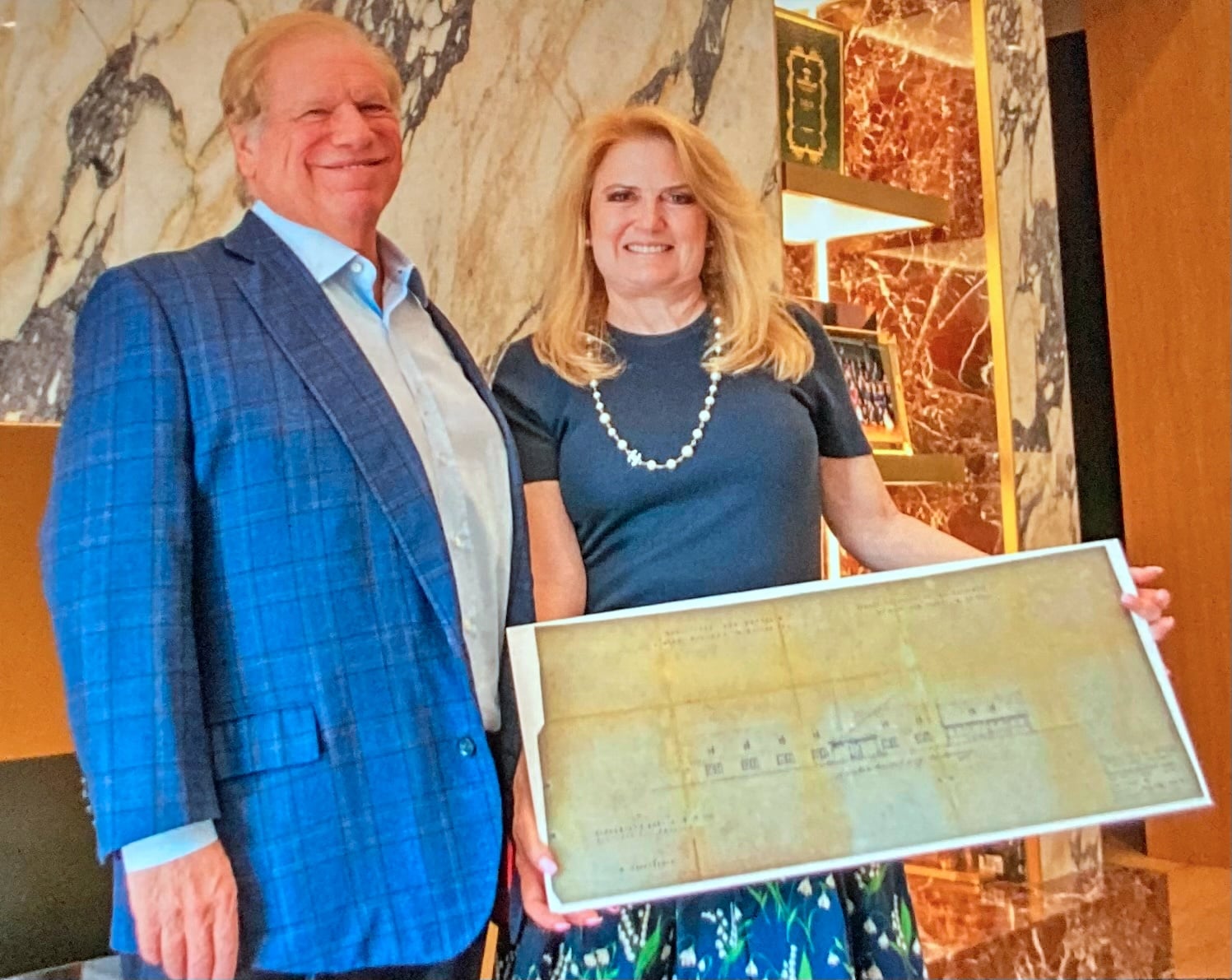
In November, Elliott and Robin Broidy of Boca Raton paid $1.5 million for an old drawing. Not a piece of fine art, but an architectural sketch drawn on cheap newsprint dated Oct. 24, 1941.
The landscape-oriented drawing, about 3 feet long and 2 feet wide, is sepia-toned with age and protected by plastic; it depicts a house of horrors: the crematoria at Auschwitz-Birkenau, where millions of Jews were systematically exterminated.
What the Broidys now own is one of only two known original drawings produced in preparation for meetings where the logistics of killing Jews on an industrial scale would be discussed.
“The drawing we have is clear proof of genocidal intent,” Elliott Broidy wrote in a Nov. 21 op-ed in The Wall Street Journal. “To behold it is to confront the deliberate design of evil. My most sincere wish is for this whiteprint to be memorialized as part of an irrefutable body of evidence that negates Holocaust denial and helps to forever silence malevolent revisionists while also educating new generations about the lessons of the Holocaust.”
Robin Broidy recalled the first time she stood before the drawing:“It’s a horrible feeling. You’re standing so close to evil. These people created this document that you’re holding in your hands with the purpose of murdering, exterminating, terminating mass numbers of people. And you’re just, you’re sad.”
The document itself is nothing special: “The paper isn’t premium,” Robin Broidy said. In wartime paper is expensive. “They were doing as much as possible on very cheap paper, so all the blueprints are on low-quality paper.”
The significance of the document lies in the date. Drawn by SS architect Walter Dejaco under the authority of Auschwitz commandant Rudolf Höss, it’s the snapshot of the moment when the men who planned the execution of millions of Jews actually put pen to paper and drew up the plan for the place the extermination would happen. The whiteprint is stark and irrefutable proof that the Shoah, the Hebrew word for the Holocaust, was conceived months before the announcement of the “final solution” in January 1942 at the Wannsee Conference.
The Broidys purchased the artifact from Rabbi David Baron of Temple of the Arts Synagogue in Beverly Hills, who had received it from a friend of a congregant who had bought it at a Nazi memorabilia auction in Germany. Neither the buyer nor seller was aware of its historical significance. According to journalist Benjamin Raziel of Forbes, the Nazis understood the power of documentation and they tried to destroy as many records as possible as the Allies approached, so finding artifacts of this import is rare.
Professor Robert Jan van Pelt, the foremost expert on Auschwitz architecture, authenticated the document, but when asked to place a value on it, Robin Broidy said, “He couldn’t. He said, ‘I can’t value it. It’s priceless.’”
In an act of remembrance and reverence, the Broidys agreed to pay $1.5 million to the Temple of the Arts for the drawing. The money would be earmarked for Baron to use to create a global early-childhood curriculum promoting empathy and altruism. The rabbi’s curriculum aims to reach children when they are young, long before extremist ideologies can take root.
“He has done research that indicates that children’s values are formed between zero to 5,” Robin said. “Therefore, if you can teach children altruism, empathy and listening to another person’s point of view then, they will be less likely to become an extremist and less likely to create hateful attitudes.”
That you become what you are taught isn’t a new idea, but Robin said, “Education is always the key. Education is the key to succeeding in life and to being a good person, getting your values straight.”
It’s also quite simple. Robin likes to tell the classic story of Rabbi Hillel, who was asked, “Can you teach the entire Torah standing on one foot?” Robin says his answer is the answer: “Sure I can. Whatever is hateful to you, do not do unto others. That’s what Jews are taught from their infancy.”
Baron told the Broidys how much money he would need to start his program, and they settled on a number. “It was a number that had some meaning,” Elliott said, “because out of the 6 million that died, 1.5 million were children.”
It’s not the first time the Broidys have stepped up like this. They’ve been actively fighting antisemitism and extremism for years. Their support turned “hell-on-earth” into a symbol of truth and light when the Counter Extremism Project transformed Rudolf Höss’ residence at 88 Legionow St. into the Auschwitz Research Center on Hate, Extremism and Radicalization (ARCHER) at House 88.
The lovely private villa with its gardens and swimming pool where the Höss family lived in comfort and affluence — Höss’ wife called it “paradise” — sits just outside the fence of Auschwitz. The Höss children played under skies darkened by the smoke rising from the crematoria next door. While they hosted lavish parties with decadent food, Jews starved just feet away.
Today the property has a mezuzah on its front door. ARCHER at House 88’s goal and message are to turn a site of mass murder into a global center dedicated to exposing the machinery of hate and educating the world. Education must begin with children, but it has to continue through adulthood. Truly, no dog is too old to learn.
Today’s battle is against misinformation and how easily it spreads. Researchers and educators, policymakers and activists work to prevent the spread of online extremism, promote safety on digital platforms and counter misinformation and radicalization.
“What ARCHER is fighting against is the mainstreaming of extremism — the same propaganda, the same misinformation, the same lies that enabled the Germans and the SS to be able to do this without a second thought, without remorse, without thinking,” Robin Broidy said. “That is the message that we are trying to send to today’s young people. Anytime somebody tries to tell you that the other someone else is less than human, don’t believe them.”
The fight continues right in our own backyard.
In January, several news agencies, including WPEC CBS12, reported that Palm Beach County sheriff’s deputies had investigated a swastika and racial slurs painted on the pavement outside Florida Cancer Specialists, a medical office plaza in West Boca. An employee discovered the white lettering which targeted both Jewish and Black communities. A discarded paintbrush and empty paint can were recovered nearby but no usable fingerprints were found. The damage was estimated at about $500, and the graffiti was quickly removed. But the implications will last.
Antisemitism is part of being a Jew, but Jews don’t fight hate with hate, Robin says: “You move on, and you try to show the world that you’re decent, wonderful human beings. You try to be positive, try to educate.”
To that end, the Broidys plan to display the whiteprint at institutions and organizations dedicated to combating antisemitism and preserving the memory of the Holocaust, before making a long-term gift of it to one institution. “Probably the Auschwitz-Birkenau Museum,” Elliott said.
The Broidys relocated to Boca Raton from Los Angeles to be closer to their children, grandchildren and about three dozen of Robin’s relatives. Elliott, chairman and CEO of Broidy Capital Holdings, is an entrepreneur, investor and philanthropist with a career spanning four decades. Robin is a former film producer and movie executive who with Elliott has been devoted to the fight against antisemitism — they call it “our major fight” — for decades.
Philanthropically, the Broidys support organizations dedicated to countering antisemitism, hate and extremism, including the Museum of Tolerance Jerusalem, the Counterterrorism Education Learning Lab (CELL), the George Washington University Program on Extremism, and StandWithUs.
“This document is our way of changing the world a little bit, if possible, and that’s no small feat,” Elliott said.
I have acquired an original architectural drawing – a “whiteprint” – of the very first design of the crematoria built in Birkenau as an expansion of Auschwitz by Austrian architect Walter Dejaco.
This piece was originally published in The Jerusalem Poston January 14, 2026.By Elliott BroidyThe massacre on Bondi Beach brought home to every Jew, everywhere, that no Jew is safe, anywhere.
As an American Jew, I watched the images of the antisemitic attack in Australia with horror – images that, like those of October 7 in Israel, brought back into our present-day lives the antisemitic violence of the past. Alongside this horror was a determination to fight back, using every means at our disposal to ensure that history is not forgotten.
As part of that fight, I have acquired an original architectural drawing – a “whiteprint” – of the very first design of the crematoria built in Birkenau as an expansion of Auschwitz.
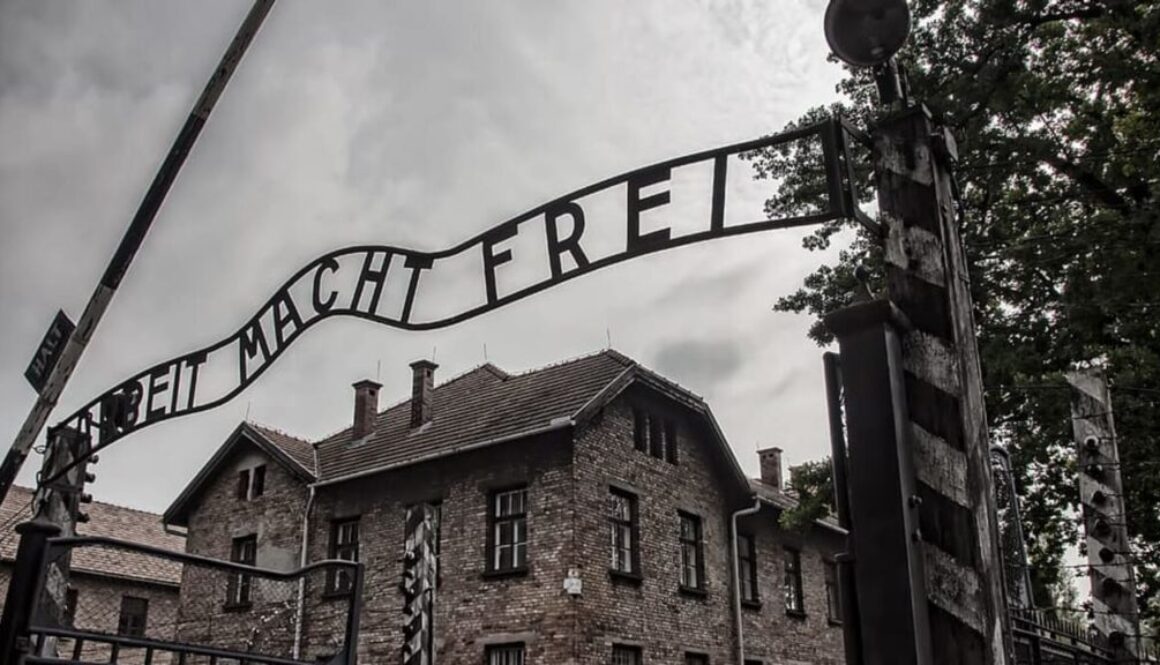
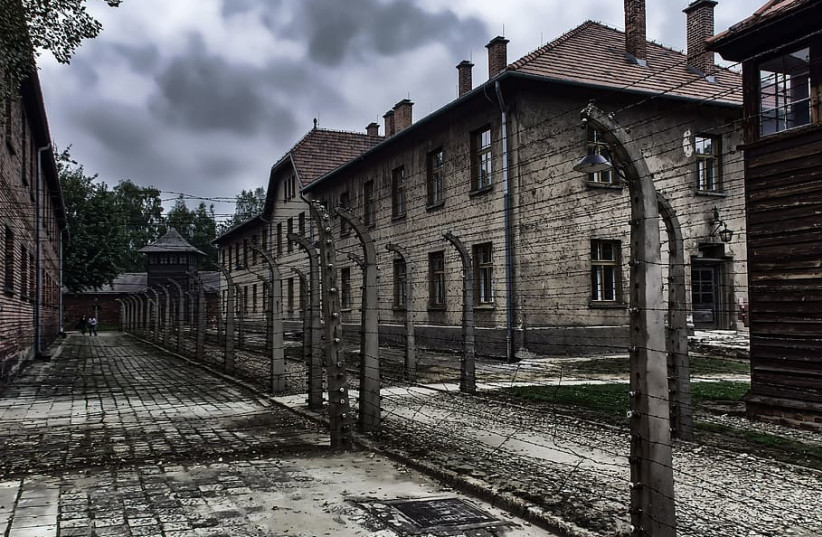
Auschwitz concentration camp, operated by Nazi Germany in occupied Poland during the Holocaust. (credit: WALLPAPER FLARE)
The term ‘genocide’
The term “genocide” was first used in a legal context at the Nuremberg Trials, which began on November 20, 1945, almost exactly 80 years ago. It was intended to describe Nazi Germany’s systematic project to annihilate, with intent, an ethnic, racial, or religious group: the Jewss.Today, however, the concept of genocide has become debased and misused, most flagrantly in accusations leveled against Israel that it has committed genocide in Gaza. Holocaust deniers, of whom there are still too many for comfort, have been joined by a large and vocal crowd – including the United Nations and governments in Europe – who abuse the term genocide by applying it to Israel’s actions in Gaza.
Prior to acquiring the whiteprint, in 2024, I helped the Counter Extremism Project, a nonprofit organization, purchase a house next door to Auschwitz. Commandant Rudolf Hoss lived there from May 1940 to December 1943, and again in early 1944, with his wife and five children. His chillingly dispassionate approach to the horror he oversaw at Auschwitz was portrayed in the Academy Award-winning film The Zone of Interest.
I obtained the whiteprint from a rabbi in the Los Angeles area, who had been given the document a decade earlier by a collector of Nazi memorabilia known to one of his congregants. The donor had come across it at an auction in Germany without knowing its true historical value.
Whiteprint ‘literally irreplaceable’
In exchange for the whiteprint, I committed to fund $1.5 million for an educational project that the rabbi is currently developing. It is an early-education curriculum on altruistic behavior – a “catch them while they are young” approach to safeguarding children from extremism. The sum is intended to honor the memory of the 1.5 million Jewish children murdered in the Holocaust.
The whiteprint is of immense historical significance. A member of my research team consulted Robert Jan van Pelt, a professor of architecture at the University of Waterloo in Canada and a leading authority on Nazi concentration camp architecture. He authenticated the whiteprint, describing it as “quite literally irreplaceable.”
Van Pelt explained that Dejaco created the design while visiting Auschwitz, where he would have been a guest of Hoss. The crematorium was initially planned to be located next to the Hoss family home, where he lived with his wife and young children. In 1942, the Nazis instead chose to build four crematoria in the nearby camp of Birkenau. These were later blown up by the Nazis as the Soviet Army advanced.
The four crematoria had an incineration capacity of nearly 4,400 corpses per day. Given their central role in the genocide of the Jews, van Pelt noted that Hoss “would have followed this project very intensely. It was a major capital outlay at a time of general rationing of resources like building materials and steel.”
Gassing and burning, starvation and disease
Although historians now estimate that approximately 1.1 million people were murdered at Auschwitz-Birkenau, roughly one million of them Jews, Hoss testified at Nuremberg that he believed the number was far higher. He stated that “at least 2,500,000 victims were executed and exterminated [at Auschwitz] by gassing and burning, and at least another half million succumbed to starvation and disease, making a total of about 3,000,000 dead.” This figure represents about 70% or 80% of all persons sent to Auschwitz as prisoners.”
Today, the two largest crematoria exist only in ruins.
Given the extraordinary rise in antisemitism across the globe and the threat it poses not only to Jews, but to Western civilization itself, we must make it impossible for anyone to deny that the Holocaust occurred. The whiteprint, in effect, makes denial untenable even for the most committed revisionists.
This piece was originally published on Voice.media on January 6, 2026.
By Alinasir Nasir
Philanthropist and entrepreneur Elliott Broidy has acquired an extremely rare artifact of historical significance: one of only two surviving original architectural drawings—a whiteprint—of the first design of the crematoria at the Auschwitz-Birkenau death camp.
According to Broidy’s announcement, the artifact is “a chilling and irrefutable piece of evidence documenting the start of the systematic, industrialized murder of millions of Jews that defined the Holocaust.”
The only other known copy is held in a Moscow archive that is inaccessible to Western scholars.
Created in October 1941 by SS architect Walter Dejaco under the direction of Auschwitz commandant Rudolf Höss, the drawing informed the design of Crematoria II and III at Birkenau, where hundreds of thousands of Jews were murdered beginning in the spring of 1943.
Broidy purchased the document for $1.5 million from Rabbi David Baron of the Temple of the Arts Synagogue in Beverly Hills, California, an amount symbolically honoring the 1.5 million Jewish children murdered in the Holocaust. The funds will support Rabbi Baron’s development of a global early-childhood curriculum focused on empathy and altruism.
In the announcement, Broidy described the whiteprint as crucial evidence at a moment of rising antisemitism and Holocaust denial. “To behold it is to confront the deliberate design of evil,” he said. “My most sincere wish is for this whiteprint to be memorialized as part of an irrefutable body of evidence that negates Holocaust denial and helps to forever silence malevolent revisionists while also educating new generations about the lessons of the Holocaust.”
The document was authenticated by renowned Auschwitz scholar Robert Jan van Pelt, the author of, among other works, Auschwitz, 1270 to the Present (with Deborah Dwork) and The Case for Auschwitz: Evidence from the Irving Trial and an expert witness for the defense in David Irving’s civil libel suit brought against Holocaust historian Deborah Lipstadt.
Van Pelt and another Holocaust historian cited in the press release, Michael Berenbaum, view the document as an especially valuable artifact because it captures the meticulousness with which the Nazis planned, engineered, and implemented mass murder.
Broidy intends to exhibit the artifact at institutions dedicated to Holocaust education and combating antisemitism before donating it permanently to such an institution. He sees this journey as an extension of his broader commitment confronting extremist ideologies, including his help in supporting the purchase and transformation of the former home of Rudolf Höss—located directly next to the Auschwitz concentration camp in Oświęcim, Poland—into the Auschwitz Research Center on Hate, Extremism and Radicalization (ARCHER) at House 88, which fights antisemitism and other forms of extremism with cutting-edge technology. Broidy co-chairs The Fund to End Antisemitism, Extremism and Hate, whose purpose is to support ARCHER at House 88.
“The Nazis sought to erase the humanity of their victims and their very existence,” Broidy said. “This artifact—and the education it will support—reasserts that humanity, helps ensure the continuity of the Jewish people, and works to build ways for all people to see the good in others.”
Last week, on Yom Kippur—the holiest day in the Jewish calendar—two Jews were murdered outside a Manchester synagogue in a horrifying antisemitic attack. In the pages of The Jewish News, Richard Ferrer lays bare the cowardice of Britain’s leadership, which has led to this terrible moment: as he notes, the first fatal antisemitic attack in Britain since the 17th century.
Something must be done. This attack has to be a wake up call. It cannot be that British Jews are expected to cower in fear, and that those who are putting them in danger—radical Islamists—are ceaselessly coddled and appeased.
The response to the violent surge in antisemitism cannot be banal remarks; what is required is naming and shaming the Islamist extremism that is driving it and taking concrete steps to counter it.
As Ferrer writes:
The question to our government is simple: what are you going to do? Not say. My God, how they love to say and say and say. Empty words won’t keep us alive. WHAT. ARE. YOU. GOING. TO. DO?
British citizens who still believe in what this country is meant to stand for need an unafraid, coordinated response to Islamist extremism and how it is being enabled by the Corbynite hard left. It must be handled with the same seriousness the state confronted the IRA in the 1980s.
Strengthen laws on incitement. Invest significantly in the Prevent programme. Fix the broken culture at the Crown Prosecution Service. Deport radical preachers and shut down “charities” funnelling money to Iranian-backed groups. Expel foreign nationals who incite violence on the streets and social media. End the indulgence of doctors, academics and others in positions of public trust who openly support Hamas. And stop the boats.
Have the courage to tell hard truths about an evil that has been indulged in plain sight. An evil that has infected our politics, culture, courts, media, education, the NHS and every other corner of public life.
Two times in two weeks. High-profile attacks on Jews in Boulder, Colo., and Washington, D.C.
A left-wing terrorist committed two antisemitic murders — in the heart of our nation’s capital, no less. Days later, a group of Jews who gathered to walk and raise awareness for the hostages held by Hamas were firebombed with home-made incendiary devices by a man in Colorado shouting “Free Palestine.”
For those of us paying attention to antisemitism, the phrase “shocked but not surprised” has become a kind of grim mantra we repeat every time we see news of the latest anti-Jewish hate crime. It never comes out of nowhere — and while many still associate antisemitism with neo-Nazis, today’s perpetrators are increasingly radical activists.
Either way, their ideology is hostile to Jews.
For neo-Nazis, Jews are somehow both contemptible subhumans and conniving puppeteers who manipulate economies and societies around the world for their own nefarious ends. This seemingly contradictory bigotry is known as “high/low” antisemitism, in which Jews are weak enough to despise but strong enough to pose a threat to white supremacy.
The left-wing antisemitic position is similarly incoherent and vile. In their paradigm, Jews used to be a vulnerable minority but forfeited that status through the founding of Israel and assimilation into American white supremacy. This narrative characterizes Jews as oppressors of other minorities whom leftists deem legitimately vulnerable, including Palestinian Arabs.
Never mind that Jews are targeted for 68% of religious-based hate crimes and 15% of all hate crimes, despite being just 2% of the American population. Never mind that Jewish Americans have neither allegiance to nor influence on the state of Israel.
I’ve talked with leftist activists on many occasions. Their favorite slogans — “From the river to the sea, Palestine will be free (or Arab)” and “globalize the intifada” are explicit calls to eliminate Israel, an undertaking that would require violent ethnic cleansing. No one worth respecting could assert that the Palestinian Authority or Hamas embrace democracy while rejecting Islamism and antisemitism.
Some activists try to distinguish their hostility to Israel from their attitudes toward Jews, but that exercise requires either extreme ignorance or grave dishonesty.
Even if one believed, as they do, that Israel is an evil apartheid state, conceived out of racism and carrying out an ongoing genocide, why have leftists attacked Jewish restaurants, Jewish university students and Holocaust museums?
Why did a man yelling “Free Palestine” shoot two attendees, neither of whom was born in Israel, at a peacebuilding conference for young diplomats? Because the murders of Yaron Lischinsky and Sarah Milgrim merely crystallized what many of us already knew: To antisemites, all Jews are guilty.
Yes, Yaron was a Messianic Jew — or a Christian, depending on who you ask. Ultimately, however, his personal faith does not affect the antisemitic nature of his murder. His killer, Elias Rodriguez, believed Yaron to be Jewish — there’s no other explanation for lying in wait outside a Jewish event hosted by a Jewish organization at a Jewish museum. The same pattern played out in Colorado, where Jewish Americans were targeted and set aflame by a pro-Palestine attacker.
Antisemitism is a societal disease that flourishes where people’s passion outstrips their knowledge, where ideology takes precedence over facts.
And I’ve seen where it leads.
I recently returned from a trip to Europe, where I visited Auschwitz and Dachau. The gas chambers, the crematoria, the cattle cars are seared into my memory, tools of a regime that was eager to blame all Jews for problems for which they were not responsible.
I don’t think America is heading toward an antisemitic genocide, but that doesn’t mean we can ignore the warnings of the Holocaust.
Not everyone who murdered Jews in the 1940s was a German soldier. There were plenty of civilians who, like Elias Rodriguez, became killers or informants out of a warped sense of “justice.”
They were ordinary people who bought into the dehumanization and demonization of Jews. They saw their atrocities as acts of righteousness.
I wish that didn’t sound so familiar.
I’m tired of being “shocked but not surprised” by violent antisemitism. I’m tired of reading every day about assaults, vandalism and genocidal protests hiding behind the cheap mask of social justice rhetoric.
The best way for us to honor Yaron and Sarah’s memory is to emphatically reject the ideology that led to their deaths. Jew-haters can’t pretend that it’s all about Israel anymore, so don’t let them.